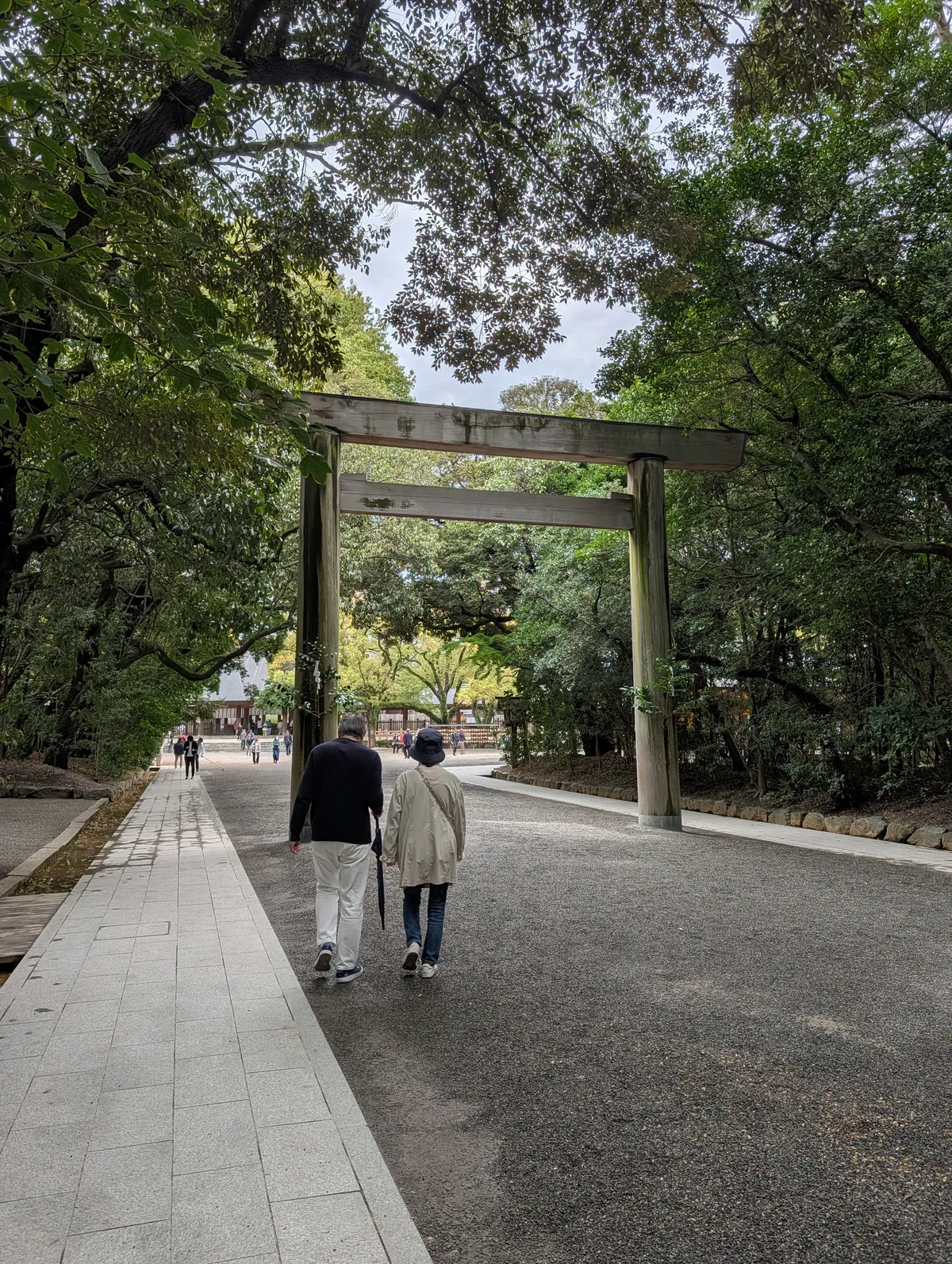

Atsuta Jingu is the Nagoya shrine that enshrines the Kusanagi-no-Mitsurugi, the legendary sword that is one of the Three Sacred Treasures of the Japanese Imperial Family. Founded roughly 1,900 years ago, it has long been regarded as second only to Ise Jingu in spiritual importance. The grounds spread across about 190,000 square meters of dense camphor forest in the middle of Nagoya, holding the main hall, the Hakkengu sub-shrine, the Treasure Museum, and a 1,000-year-old sacred camphor tree. It is about 25 minutes by subway from Nagoya Station, free to enter, and open 24 hours a day. This guide is written by a Nagoya local who has visited the shrine every New Year of his working life and covers access, highlights, goshuin, major festivals, and the nearby Hourai-ken honten — the birthplace of hitsumabushi, just a 3-minute walk from the south gate.
Last updated: May 2026 | Author: Yuu (born and raised in Nagoya, 35 years local)
This article may contain affiliate links. See our affiliate disclosure for details.
Table of Contents
- What Is Atsuta Jingu? — The Sacred Sword and 1,900 Years of History
- Access: How to Get to Atsuta Jingu from Nagoya Station
- Hours, Fees, and Practical Basics
- 7 Highlights: From the Main Hall to the Great Camphor
- Goshuin Stamps: Where, How Much, Which Ones
- Major Festival Calendar
- Nearby Food: Hourai-ken Honten — Birthplace of Hitsumabushi
- Where to Stay Near Atsuta Jingu
- Sample Itineraries: Half-Day and Full-Day Plans
- Visiting Tips: Crowds, Etiquette, and Photo Manners
- Frequently Asked Questions
- About the Author
- Related Guides
What Is Atsuta Jingu? — The Sacred Sword and 1,900 Years of History
Atsuta Jingu is a Shinto shrine in Atsuta Ward, Nagoya, best known for enshrining the Kusanagi-no-Mitsurugi (the Grass-Cutting Sword) — one of the Three Sacred Treasures of the Japanese Imperial Family. The Three Sacred Treasures are the symbols of imperial legitimacy: the Yata-no-Kagami (mirror), the Yasakani-no-Magatama (jewel), and the Kusanagi-no-Mitsurugi (sword). They are essential ritual objects in the enthronement of every Japanese emperor.
The principal deity is Atsuta-no-Okami, the divine spirit dwelling in the Kusanagi sword. Five companion deities are also enshrined: Amaterasu-Omikami, Susano-o-no-Mikoto, Yamato-Takeru-no-Mikoto, Miyazu-hime-no-Mikoto, and Take-Inadane-no-Mikoto.
Source: Atsuta Jingu Official Site — About Atsuta Jingu for the official information on the enshrined deities and shrine history.
The Story of the Kusanagi Sword
According to mythology, the sword was discovered when Susano-o-no-Mikoto slew the eight-headed serpent Yamata-no-Orochi and pulled the blade from its tail. Generations later, Yamato-Takeru-no-Mikoto, the legendary prince, used the sword on a campaign in eastern Japan to cut down burning grass and save himself from a fire trap — which is how the blade earned the name “Kusanagi” (grass-cutting). After Yamato-Takeru’s death, his consort Miyazu-hime enshrined the sword in Atsuta. That moment is traditionally recorded as the founding of Atsuta Jingu, roughly 1,900 years ago.
The Kusanagi sword itself is housed deep inside the inner sanctuary and cannot be viewed by ordinary visitors. This is the same arrangement as the Yata-no-Kagami at Ise Jingu — the holiest objects of the imperial faith are kept in strict seclusion.
Source: Atsuta Jingu Official Site — Enshrined Deities for the mythological background of the Kusanagi sword.
Why It Is Called “Second Only to Ise Jingu”
Atsuta Jingu has long been ranked second only to Ise Jingu in spiritual standing. The reason is structural: of the three sacred imperial treasures, the Yata-no-Kagami sits at Ise and the Kusanagi sword sits at Atsuta. From the Kamakura period onward, samurai houses also paid deep respect to the shrine. Oda Nobunaga famously prayed here for victory before the Battle of Okehazama in 1560, and after winning he donated the surviving Nobunaga-bei wall as an offering of thanks.

For people from Nagoya, Atsuta Jingu is “the shrine you go to when you start the working year”. I personally make the visit every January right after the New Year break, before opening up the year’s work. The grounds in early January are lined with food stalls — oden, sweet amazake sake, kishimen noodles, takoyaki octopus balls, all the warm Nagoya stall food at once. The combination of solemn worship at the main hall and the cheerful, almost festival-like buzz of the stalls is what makes Atsuta different from any other major shrine in Japan. You get reverence and comfort in the same hour.
Access: How to Get to Atsuta Jingu from Nagoya Station
Atsuta Jingu sits in the southern part of Nagoya, in Atsuta Ward. From Nagoya Station you can reach it by subway, JR, or Meitetsu line, all of which are easy to navigate even for first-time international visitors.
Public Transportation
| From | Line | Nearest Station | Travel Time | Fare (one-way) |
|---|---|---|---|---|
| Nagoya Station | Subway Meijo Line (transfer at Kanayama) | Jingu-Nishi / Tenma-cho | ~25 min | 240 yen |
| Nagoya Station | JR Tokaido Main Line | JR Atsuta Station | ~6 min | 190 yen |
| Meitetsu Nagoya Station | Meitetsu Nagoya Main Line | Jingu-mae Station | ~7 min | 240 yen |
The most straightforward option is Meitetsu “Jingu-mae” Station. Exit the gate, walk west for about 3 minutes, and you arrive at the East Gate. From JR Atsuta Station, the West Gate is about an 8-minute walk. By subway, use “Jingu-Nishi” Station for the West Gate or “Tenma-cho” Station for the South Gate.
Source: Atsuta Jingu Official Site — Access for the official station list and walking times.
Choosing Your Entry Gate
Atsuta Jingu has three main entrances, each with a different feel.
- South Gate (Main Gate): From subway “Tenma-cho” Station. This is the full ceremonial route — you walk through the first, second, and third torii gates in order before reaching the main hall. The most reverent and traditional approach.
- East Gate: From Meitetsu “Jingu-mae” Station. The shortest route to the main hall. Best if your sightseeing time is limited.
- West Gate: From subway “Jingu-Nishi” Station. Closest to the parking lot and the Treasure Museum. Best if you are driving or specifically going for the museum.
For a first visit, the route I recommend is enter from the South Gate and exit through the East Gate. That way you get the full forest-bathing effect of the main approach.
From Chubu Centrair International Airport
If you are coming directly from the airport, take the Meitetsu Mu-Sky limited express to “Jingu-mae” Station — about 30 to 35 minutes (450 yen reserved-seat fee plus 890 yen base fare). For travelers who want to start sightseeing immediately, stopping at Atsuta Jingu before hotel check-in is a clean and efficient plan.
For the broader Nagoya transit picture, see our companion guide: Getting Around Nagoya — Subway, Meitetsu, and Bus Made Simple.
Hours, Fees, and Practical Basics
Here is the practical information you need before visiting.
Basic Information
| Address | 1-1-1 Jingu, Atsuta-ku, Nagoya 456-8585 |
| Admission | Free |
| Worship hours | 24 hours (grounds always open) |
| Reception desk (amulets, goshuin) | 7:00 to sunset (varies by season) |
| Treasure Museum | 9:00-16:30 (last entry 16:10) |
| Treasure Museum admission | Adults 500 yen / elementary & junior high 200 yen |
| Treasure Museum closed | Last Wednesday and Thursday of each month, December 25-31 |
| Parking | Free (about 400 spaces, worshippers only) |
| Official site | https://www.atsutajingu.or.jp/ |
Source: Atsuta Jingu Official Site for hours and Treasure Museum fees. Fees and hours can change — always verify on the official site before your visit.
Key Points for Visiting
- The grounds themselves are free. The main hall, sub-shrines, the great camphor tree, and all major spots can be visited at no extra cost.
- The Treasure Museum and Kusanagi-kan charge separately. They display non-divine treasures — swords, ancient documents, ceremonial garments — and are essential for sword fans.
- Early morning is the best window. Because the grounds are open 24 hours, a 6:00-7:00 AM visit gives you a quiet, almost private walk through the camphor forest. The light is also ideal for photography.
7 Highlights: From the Main Hall to the Great Camphor
The grounds are large enough that you should plan a route. For a half-day visit that covers everything important, here is the order I recommend.
1. The Three Torii Gates
From the South Gate, you pass through three large torii gates in succession on the way to the main hall. The path is gravel, surrounded by an old camphor forest, and feels like the urban-shrine-forest experience you get at Meiji Jingu in Tokyo or Shimogamo Jinja in Kyoto. The main approach is about 400 meters long — roughly a 7-minute walk to the main hall.
2. The Main Hall (Honguu)
The central sanctuary of Atsuta Jingu — the most sacred spot, where the Kusanagi sword is enshrined. Worshippers pray here using the standard form: two bows, two claps, one bow. The current building was rebuilt in 1955 (Showa 30) in the same shinmei-zukuri style as Ise Jingu, with a cypress-bark roof and the distinctive crossed chigi and cylindrical katsuogi on the ridge.
Photography from in front of the worship hall is permitted, but the inner sanctuary is off-limits. Avoid flash and tripods.
3. Hakkengu Sub-Shrine
Located southwest of the main hall, Hakkengu was founded in 708 (Wado 1) and is dedicated to the spirit of the Kusanagi sword as a parallel sanctuary. It draws fewer visitors than the main hall, which makes it a much quieter place to pray. Locals routinely visit both — the convention is to bow at the main hall first, then at Hakkengu.
4. Kusu-no-Maeshasa (Children’s Shrine)
Also known as Koyasu-jinja, this small shrine is dedicated to the deities of safe childbirth and fertility. It sits at the base of an old camphor tree and draws many local couples and expectant mothers. The amulets and ema prayer plaques here are mostly child-rearing themed. A natural stop for families traveling with children.
5. The Great Camphor (Okusu) — A 1,000-Year-Old Sacred Tree
The biggest power spot in the grounds. The Okusu is a roughly 1,000-year-old camphor tree said to have been planted by the monk Kukai (Kobo Daishi). The trunk circumference is over 7 meters and the canopy towers above the surrounding buildings. It is also believed to be the home of a sacred white snake, and you will sometimes see worshippers leaving raw eggs at the roots as offerings.

Source: Atsuta Jingu Official Site — About the Grounds for information on the camphor’s age and traditions.
6. Nijugocho-bashi Bridge
A stone arch bridge spanning the South Pond, named for the 25 stone planks used in its construction. It is celebrated in the local Nagoya Jinku folk song and is a designated cultural property of the city. The bridge itself is a preservation object and cannot be crossed, but the view across the pond is genuinely beautiful.
7. Nobunaga-bei Wall
A tsuiji clay wall donated in 1560 by Oda Nobunaga in thanks for his victory at the Battle of Okehazama. Counted among Japan’s three great tsuiji walls, it is built up in alternating layers of clay and limestone. A must-see for anyone interested in samurai history.
Bonus: The Treasure Museum and Kusanagi-kan
Separate admission (500 yen for adults). The collection runs to about 6,000 objects, including National Treasures and Important Cultural Properties — swords (such as the famous tanto blade “Rai Kunitoshi”), ancient documents, ceremonial garments, and paintings. Exhibits rotate, so sword fans should check the schedule.
Source: Atsuta Jingu Official Site — Treasure Museum for collection size and major holdings.

Goshuin Stamps: Where, How Much, Which Ones
A goshuin is a calligraphy-and-stamp record of your visit, given by the shrine. They have become increasingly popular with international travelers in recent years.
Where to Receive It
Goshuin are issued at the juyo-sho reception desk on the south side of the main hall.
- Hours: 7:00 to sunset (until about 19:00 in summer, 16:30 in winter)
- Fee: 500 yen per stamp
- Goshuin notebooks: Original Atsuta Jingu notebooks are sold at the reception desk (around 1,500 yen)
The Three Goshuin You Can Collect
Atsuta Jingu offers more than one goshuin.
- Atsuta Jingu Honguu (main hall) goshuin — the basic one
- Hakkengu sub-shrine goshuin — issued separately
- Kami-Chikama-jinja goshuin — a small affiliated shrine inside the grounds
Collecting all three completes the “Atsuta Three-Shrine Pilgrimage”. For a first visit, just the main hall goshuin is enough, but if you are a collector, doing all three is satisfying.
The proper order is worship first, goshuin second. Walking up to the desk and getting the stamp without bowing at the main hall first goes against the original meaning. Always pray at the main hall, then walk to the reception desk.
Source: Atsuta Jingu Official Site — Amulets and Goshuin for official details on offerings and fees.
Major Festival Calendar
Atsuta Jingu hosts more than 70 ceremonies and rituals a year. Here are the major events that travelers can realistically attend, in seasonal order.
January 1-3: Hatsumode (New Year Worship)
The first three days of the year draw about 2.3 million visitors, making Atsuta the most-visited shrine in Aichi Prefecture for hatsumode. Food stalls fill the grounds — oden, sweet amazake, kishimen noodles, takoyaki — and the atmosphere is bright and festive. Peak crowds run from 10:00 to 15:00 on January 1. Visit either early morning (6:00-8:00) or after dark for a calmer experience.
I personally come to Atsuta Jingu every year for shigotohajime — the day I officially start the working year. I aim for around January 4 or 5: the worst of the New Year crowds has eased, but the food stalls are still operating, so you get both the calm of post-holiday worship and the warmth of stall food in one trip. There is no better way to start a working year in Nagoya.
January 7: Touka-Shinji
A Heian-era ritual designated as a National Important Intangible Folk Cultural Property. Shinto priests divide into “singers” and “dancers” and perform an old-style prayer for a bountiful harvest in front of the main hall. Free to watch.
May 5: Jinmu-sai
A children-focused ritual day, with kyudo (Japanese archery) competitions. A good day to visit with families.
June 5: Atsuta Matsuri (Shobu-sai) — The Big One
The largest festival of Atsuta Jingu’s year. About 1,000 fireworks are launched at Jingu Park, the approach is lined with food stalls, and the day’s program includes kendo, kyudo, a tea ceremony offering, and kagura ritual dance. Roughly 250,000 people attend each year.
Source: Atsuta Jingu Official Site — Atsuta Matsuri for the official program and dates.
June 18: Otaue-sai (Rice-Planting Festival)
Young rice seedlings are ceremonially planted in the shrine’s sacred field as a prayer for a good harvest. The participants wear traditional rice-planting garments — an excellent photography opportunity.
October: Reisai (Annual Grand Festival)
One of the most important rituals of the year. An imperial messenger is dispatched, and bugaku and kagura are offered at the main hall.
For the full Central Japan festival cycle, see our companion guide: Central Japan Festival Calendar — Year-Round Guide.
Nearby Food: Hourai-ken Honten — Birthplace of Hitsumabushi
If you are at Atsuta Jingu, there is one place you should not miss — and it is right next door: the original birthplace of hitsumabushi.
Atsuta Hourai-ken Honten (3 minutes from the South Gate)
Founded in 1873 (Meiji 6), Hourai-ken honten is the restaurant credited with inventing hitsumabushi. It sits a 3-minute walk from Atsuta Jingu’s South Gate — about the best possible location for a post-worship meal.
- Address: 503 Godo-cho, Atsuta-ku, Nagoya
- Hours: 11:30-14:00 / 16:30-20:30 (lunch last entry 14:30)
- Closed: Wednesdays, 2nd and 4th Thursdays
- Price range: Hitsumabushi from 4,600 yen / Una-don from 3,800 yen
- Reservations: Same-day numbered ticket system (some online booking available)
Because of the fame, multi-hour waits are completely normal. The local trick is to pick up a numbered ticket before worshipping at the shrine, and use the wait time as your sightseeing time.

I have eaten hitsumabushi in Nagoya over 100 times, and Hourai-ken honten’s charcoal-grilled birthplace flavor still feels different from anywhere else. When I bring overseas guests there, I almost always hear the same line afterward: “once I get home I won’t be able to eat eel the same way again.” That is the kind of impact this single shop has.
Source: Atsuta Hourai-ken Official Site for hours and the official reservation procedure.
Want to Go Deeper Into Hitsumabushi?
Hourai-ken is not the only excellent hitsumabushi shop in Nagoya — far from it. For a 16-restaurant survey written by the same Nagoya local who has eaten the dish 100+ times, including how to eat it in 4 stages and where to go when Hourai-ken is full, see our complete guide: Hitsumabushi Complete Guide — 16 Restaurants Reviewed by a Nagoya Local Who’s Eaten It 100+ Times.
Other Nearby Food
- Kiyome-mochi Sohonke: A traditional Atsuta sweet — soft white mochi rice cake with smooth red bean paste inside. The shop was founded in 1864 and is a classic post-worship souvenir.
- Miya Kishimen Jingu Branch: A kishimen flat-noodle specialist inside the shrine grounds. Quick, affordable, and locally priced — a good light option mid-visit.
- Atsuta Hourai-ken Jingu Branch: A nearby alternative when the honten is fully booked. About 8 minutes on foot from the main shop.
To book a hands-on hitsumabushi experience or a guided shrine tour:
[KLOOK:hitsumabushi-experience] [KLOOK:atsuta-shrine-tour]
Where to Stay Near Atsuta Jingu
Most international travelers base themselves around Nagoya Station (Meieki) or Sakae, which both put Atsuta Jingu within 25 minutes by train. There is no real reason to stay in Atsuta Ward itself — the area is residential, and you will get a much wider choice of hotels and restaurants in the central business districts.
For a solo or business trip, the Meieki area near Nagoya Station is the most convenient: easy airport access via Mu-Sky, multiple subway lines, and a short Meitetsu ride to Jingu-mae for the shrine. Sakae is the better pick if you want shopping, nightlife, and a base near restaurants for evening dining after a daytime shrine visit.
For ready-made hotel options near both bases, see:
[BOOKING:hotel-near-jingu] [AGODA:nagoya-shrine-area]
For a full Nagoya hotel comparison and our top recommendations, the Nagoya 3-Day Itinerary includes recommended bases for each kind of traveler.
Sample Itineraries: Half-Day and Full-Day Plans
Half-Day Plan (3-4 hours): Worship + Lunch
| Time | Activity |
|---|---|
| 10:00 | Arrive at Meitetsu “Jingu-mae” Station, enter via the East Gate |
| 10:10 | Worship at the main hall |
| 10:40 | Visit Hakkengu sub-shrine |
| 11:00 | Walk the great camphor, Nijugocho-bashi, and Nobunaga-bei |
| 11:30 | Pick up a numbered ticket at Hourai-ken honten (or head to the Jingu branch) |
| 12:00 | Hitsumabushi lunch |
| 13:30 | Receive goshuin and amulets |
| 14:00 | Return to central Nagoya from Jingu-mae Station |
Full-Day Plan: Atsuta + Kanayama + Nagoya Castle
| Time | Activity |
|---|---|
| 9:00 | Atsuta Jingu worship (South Gate to main hall) |
| 11:00 | Treasure Museum visit |
| 12:00 | Hitsumabushi lunch at Hourai-ken honten |
| 14:00 | Move to Kanayama Station (one stop on Meitetsu) |
| 14:30 | Light shopping or coffee around Kanayama Station |
| 15:30 | Move to Nagoya Castle (city bus or subway) |
| 18:00 | Dinner in Sakae |
For a full Nagoya itinerary including Atsuta Jingu, see Nagoya 3-Day Itinerary — A Local’s Complete Plan.
Visiting Tips: Crowds, Etiquette, and Photo Manners
Crowd Calendar
| Period | Crowd Level | Notes |
|---|---|---|
| January 1-3 (Hatsumode) | Extreme | ~2.3 million visitors. 2-hour wait to reach the main hall is possible |
| January 4-7 | Moderate | Stalls still operating, crowd roughly cut in half |
| June 5 (Atsuta Matsuri) | Extreme | ~250,000 visitors for the fireworks |
| Weekday morning (7:00-10:00) | Empty | Quietest, best for photography |
| Weekend midday (11:00-14:00) | Moderate | Lots of overflow from Hourai-ken queue |
For a first visit, weekday mornings are by far the best. The air is clear, the light through the camphor forest is beautiful, and you can walk the approach feeling like the forest belongs to you.
Worship Etiquette (the Basics)
- Bow before passing through the torii gate — a small, deliberate bow.
- Purify at the chozu-ya basin: hold the ladle in your right hand, rinse left hand, then right, then mouth.
- At the main hall: drop a coin in the offering box, then perform two bows, two claps, one bow (deep bow x2, clap x2, deep bow x1).
- Bow once more when leaving, after passing back through the torii.
Atsuta Jingu uses the standard “two bows, two claps, one bow” form, the same as Ise Jingu — not the four-clap form used at Izumo Taisha.
Photography Manners
- No photography inside the inner sanctuary or during priestly rituals.
- Tripods and selfie sticks are generally not allowed (the main approach is OK, in front of the main hall is not).
- Avoid framing other worshippers in close-ups.
- The great camphor, the torii, and Nijugocho-bashi are fine to photograph.
As foreign visitor numbers grow, polite worship is the single thing locals appreciate most. A few minutes of attention to etiquette goes a long way.
What to Wear and Bring
- Comfortable walking shoes are essential — most paths are gravel and the main approach is 400 meters one way.
- Summer (June-September) heat protection: the forest provides cover but the open sections of the approach get full sun.
- Winter (December-February) layering: gloves are useful for early-morning visits.
- Small change for offerings, amulets, and goshuin.
Frequently Asked Questions
How long does a visit to Atsuta Jingu take?
Just the main hall takes about 30 minutes. To cover the major highlights (main hall, Hakkengu, the great camphor, Nijugocho-bashi, Nobunaga-bei) plan 90 to 120 minutes. Add the Treasure Museum and you should plan 2.5 to 3 hours.
Can I actually see the Kusanagi sword?
No. The sword is enshrined deep inside the inner sanctuary as the shrine’s sacred object and is also a focus of imperial ritual, so it is not open to public viewing. This is the same arrangement as the Yata-no-Kagami at Ise Jingu.
Is there an admission fee?
Visiting the shrine grounds is completely free. Only the Treasure Museum charges admission — 500 yen for adults.
Is English signage and assistance available?
The official website has English pages, and the main signposts inside the grounds carry English. Goshuin and amulets are written in Japanese, but the reception desk usually has English-speaking staff on duty.
Can I watch a Shinto wedding or shichi-go-san at the shrine?
Atsuta hosts Shinto weddings frequently, and watching from a respectful distance is fine. Do not block the wedding party or step in close. Shichi-go-san ceremonies for children peak around November 15, when you will see kids in traditional kimono throughout the grounds.
Atsuta Jingu or Nagoya Castle — which should I prioritize?
History fans should visit both — each takes about half a day. Choose Atsuta Jingu for the experience of Japanese mythology and the imperial regalia tradition. Choose Nagoya Castle for samurai-era architecture and castle-town history. They pair very well in a single day.
Is it worth visiting in the rain?
Absolutely. Most of the grounds are sheltered by ancient trees, and a small umbrella is enough. The Treasure Museum is fully indoors, and Hourai-ken honten next door is also indoor dining. Rain thins the crowds, so it can actually be a great day to come.
About the Author
Yuu was born in Nakagawa Ward, Nagoya, and has lived in the city for 35 years. After years of working in Sakae and walking every corner of central Nagoya, he now lives in the Osu shopping district. He visits Atsuta Jingu every January for shigotohajime — the day he formally starts the working year — and has done so for as long as he has been working. He has eaten hitsumabushi 100+ times across 16 restaurants in Nagoya. When showing visitors from overseas around the city, he tries to share the version of central Japan that does not appear in standard guidebooks: the local rituals, the right entry gate, the food stall to walk to first.
Related Guides
- Hitsumabushi Complete Guide — 16 Restaurants Reviewed by a Nagoya Local Who’s Eaten It 100+ Times
- Things to Do in Nagoya — Complete Sightseeing Guide
- Getting Around Nagoya — Subway, Meitetsu, and Bus Made Simple
- Nagoya 3-Day Itinerary — A Local’s Complete Plan
- Nagoya Castle Complete Guide — Honmaru Palace, Cherry Blossoms, and Local Tips
- Central Japan Festival Calendar — Year-Round Guide